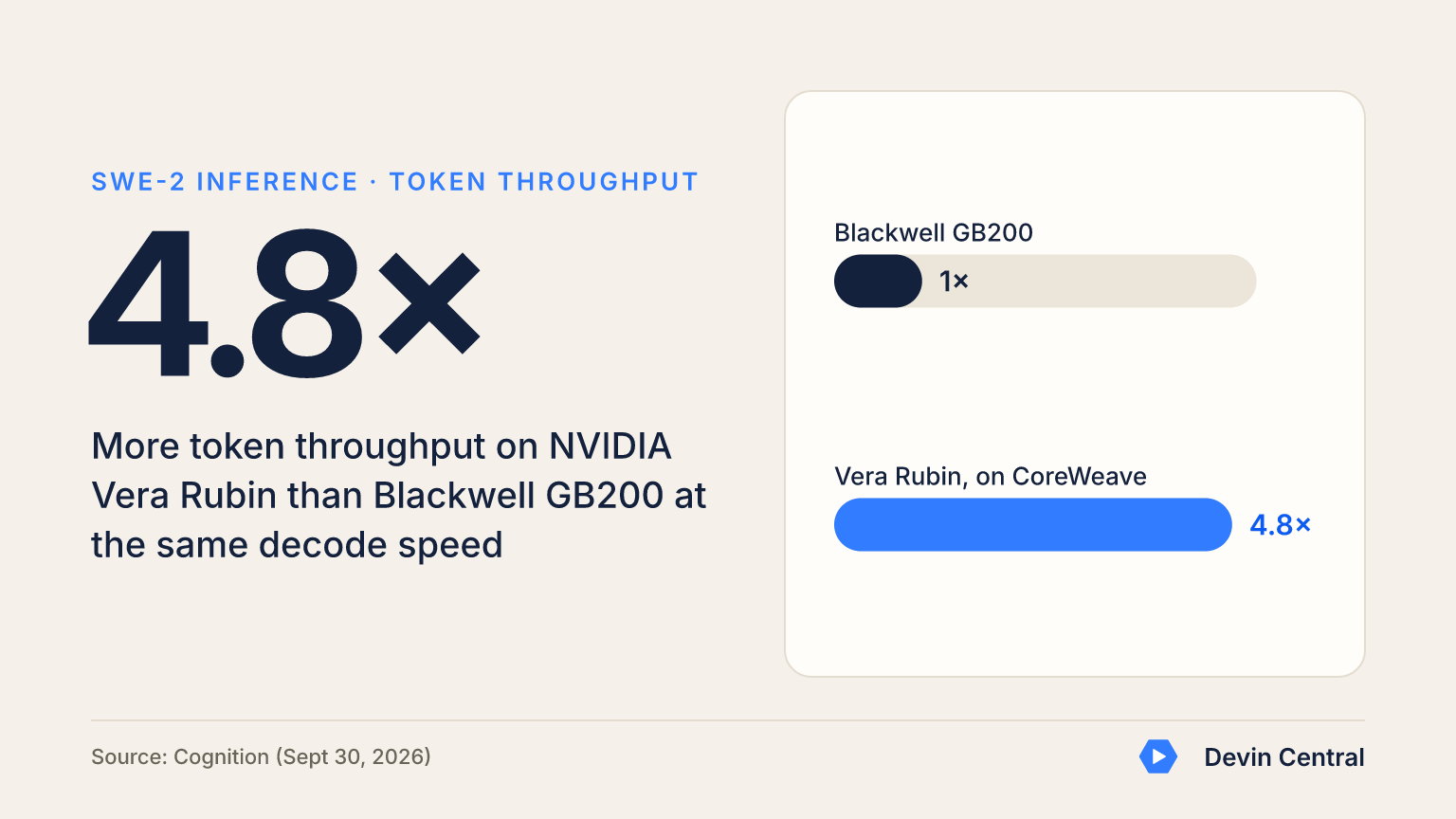
On September 30, Cognition announced that it is NVIDIA’s first customer running Vera Rubin, the chip architecture that follows Blackwell in NVIDIA’s AI accelerator roadmap. The deployment runs on CoreWeave infrastructure, and Cognition reports that Vera Rubin delivers 4.8x more token throughput than Blackwell GB200 at the same decode speed for SWE-2 inference workloads.
This is a milestone for both companies: NVIDIA gets its first production customer for Vera Rubin (which hasn’t even launched publicly yet), and Cognition gets early access to hardware that makes its frontier coding model nearly 5x faster without changing the model itself.
The hardware progression: Hopper → Blackwell → Vera Rubin
Cognition’s post frames the announcement as a timeline:
- Hopper (H100) in 2022 — the chip that trained GPT-4 and powered Devin’s early inference.
- Blackwell (GB200) in 2024 — NVIDIA’s current flagship, which Cognition adopted for SWE-1.7 and SWE-2 training.
- Vera Rubin now — NVIDIA’s next-gen architecture, not yet publicly available, which Cognition is running via CoreWeave’s early-access program.
The 4.8x throughput gain means that for the same model (SWE-2) and the same quality of output, Cognition can serve 4.8x more requests per chip, or equivalently, cut inference latency by 4.8x if they keep the same cluster size. That’s a direct cost and speed improvement — no model retraining required.
What “same decode speed” means
Cognition’s announcement specifies that Vera Rubin delivers 4.8x more token throughput at the same decode speed. That phrasing is important, because there are two ways to make inference faster:
-
Higher decode speed: Generate each token faster (e.g., 50ms per token instead of 100ms). This reduces latency — the user sees output sooner — but doesn’t change throughput (tokens per second per chip).
-
Higher throughput: Batch more requests onto the same chip, so you generate more total tokens per second, even if each individual token still takes the same time.
Vera Rubin’s 4.8x gain is throughput, not latency. That means Cognition can pack 4.8x more SWE-2 sessions onto the same hardware, but each session still runs at the same speed (roughly 1,000 tokens/second for SWE-2 on Cerebras, per Cognition’s July announcement). For a company running millions of sessions daily, throughput is what matters — you want to maximize how many users you can serve per chip, not just how fast one user’s session runs.
The CoreWeave partnership
CoreWeave is a GPU cloud provider that specializes in high-performance AI workloads. The company operates data centers with NVIDIA’s latest hardware, often getting chips months before AWS, Google Cloud, or Azure. Cognition has been a CoreWeave customer since at least 2024, per Cognition’s Series C announcement in April 2024, which listed CoreWeave as an infrastructure partner.
The Vera Rubin deployment extends that partnership: CoreWeave secured early access to Vera Rubin chips (likely through NVIDIA’s “Inception” program for strategic customers), and Cognition became the first production workload running on them. This is a co-marketing win for both sides: CoreWeave gets to say it’s the cloud that powers Cognition’s $1B ARR business, and Cognition gets first access to hardware that cuts its inference costs by 80%.
The post doesn’t specify how many Vera Rubin chips Cognition is running, but the phrasing “powered by CoreWeave” suggests it’s a full cluster, not a pilot. For context, Cognition’s Blackwell deployment (announced in March 2026) was reported as “hundreds of GB200 nodes” by The Information, which would be roughly 1,000–2,000 GPUs. A 4.8x throughput improvement means Cognition could replace that entire cluster with 200–400 Vera Rubin GPUs and maintain the same inference capacity.
The timing: Vera Rubin isn’t even launched yet
NVIDIA has not publicly announced Vera Rubin’s launch date, pricing, or specs. The architecture name appeared in NVIDIA’s September 2026 investor roadmap (shared at GTC 2026 keynote), but no product SKUs have been released. That makes Cognition’s deployment the first public confirmation that Vera Rubin exists in production, not just on a roadmap slide.
This is consistent with how NVIDIA seeds new architectures: give early access to a handful of marquee customers (OpenAI, Meta, Microsoft, and now Cognition), let them validate the hardware in production, then use their testimonials in the official launch. Cognition’s 4.8x throughput claim will likely appear in NVIDIA’s Vera Rubin launch deck when the chip is formally announced (expected Q4 2026, per industry analysts).
Method: The 4.8x throughput figure, "same decode speed" phrasing, and hardware timeline (Hopper 2022, Blackwell 2024, Vera Rubin now) are from Cognition's September 30 X post. CoreWeave as Cognition's infrastructure partner is from Cognition's April 2024 Series C announcement. The Blackwell cluster size estimate (hundreds of GB200 nodes, 1,000–2,000 GPUs) is from The Information's March 2026 report on Cognition's GPU spend. NVIDIA's Vera Rubin roadmap mention is from the September 2026 GTC keynote transcript. The Q4 2026 launch estimate is from analyst reports (e.g., Mizuho Securities' October 2026 NVIDIA coverage).
References
- Cognition is the first customer running NVIDIA Vera Rubin — Cognition, September 30, 2026.
Editorial from Devin Central — news coverage by a Devin Ambassador, not Cognition. Devin is a trademark of Cognition; NVIDIA and Vera Rubin are trademarks of NVIDIA Corporation.