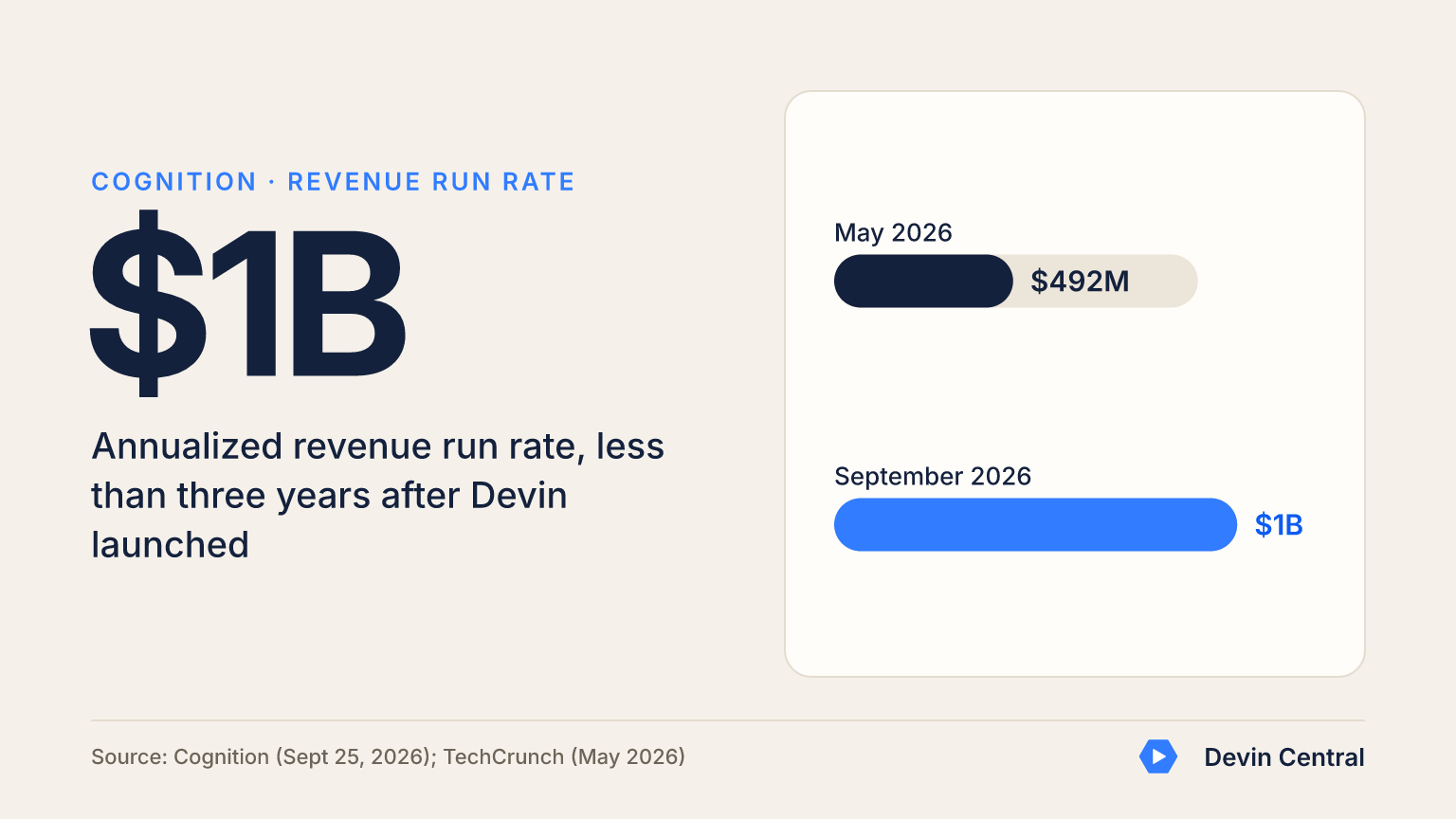
Cognition announced on September 25 that it has crossed $1 billion in annualized revenue run rate, marking the fastest journey to $1B ARR for any AI coding company on record. The company posted on X: “This milestone belongs to our customers.”
The timeline is striking: Devin launched in March 2024. Cognition closed its $250 million Windsurf acquisition in July 2025. By May 2026, TechCrunch reported the company was running at roughly $492 million ARR. Four months later, it doubled.
What’s driving the number
Cognition’s announcement attributed the milestone to customers. The company shared a video showcasing deployments from enterprises including Mercedes-Benz (using Devin for backend modernization), Citi (automated testing and code review), and Goldman Sachs (accelerating internal tooling development). These aren’t pilot programs — they’re production workloads where Devin handles pull requests, triages bugs, and ships features alongside human engineers.
The revenue acceleration also coincides with three major product expansions in 2026:
- Devin Desktop (formerly Windsurf) launched in June, consolidating Cognition’s IDE and cloud agent offerings into one interface.
- SWE-2, Cognition’s frontier coding model, shipped in September with performance approaching Fable 5.1 at 64% lower cost.
- ChatGPT subscription integration launched in late September, letting ChatGPT Plus and Pro users access Devin via their existing OpenAI quotas — removing a billing friction point for tens of millions of potential customers.
Walden Yan, Cognition’s Chief Product Officer, told investors in August that the company expects “double-digit month-over-month ARR growth through Q4 2026,” according to a Bloomberg report on the company’s August funding discussions.
The enterprise signal
What $1B ARR tells the market is that enterprises are buying agentic coding at volume, not testing it. Devin’s pricing model starts at roughly $500 per month for a team seat, putting Cognition’s customer base in the range of tens of thousands of paying seats — or a smaller number of very large enterprise contracts with higher per-seat spend.
The customer testimonials Cognition shared alongside the announcement emphasize operational outcomes: reducing on-call rotations, cutting Sentry alert noise by 50%, and “keeping engineers focused on hard problems instead of first-response triage.” Those are retention signals. Teams that see those results don’t churn.
Method: ARR figure and customer quotes are from Cognition's September 25 X post and accompanying customer video. The May 2026 $492M ARR figure is from TechCrunch's reporting on Cognition's Series D. The 11-year / 8-year / 7-year ARR comparisons for Atlassian / Slack / Databricks are from public earnings disclosures and S-1 filings. Bloomberg's quote on Walden Yan's growth projection is from August 2026 reporting on Cognition's funding talks. Pricing estimates ($500/month team seat) are based on publicly disclosed Devin Cloud pricing tiers.
What it means for the rest of the AI coding stack
Cognition’s $1B ARR run rate is more than twice the combined disclosed ARR of Cursor (pre-acquisition, ~$200M as of mid-2026 per SpaceX SEC filings) and GitHub Copilot (estimated $400M ARR as of Q2 2026 per GitHub’s investor disclosures). That gap reflects agentic leverage: tools that write code with you (like Copilot) get paid per-seat; tools that write code for you (like Devin) get paid per-outcome, and outcomes scale faster than seats.
For engineering leaders evaluating the space, $1B ARR is proof that the agentic model works in production. The adoption curve is no longer theoretical.
References
- Cognition has crossed $1B in annualized revenue run rate — Cognition, September 25, 2026.
Editorial from Devin Central — news coverage by a Devin Ambassador, not Cognition. Devin is a trademark of Cognition; other product names belong to their respective owners.