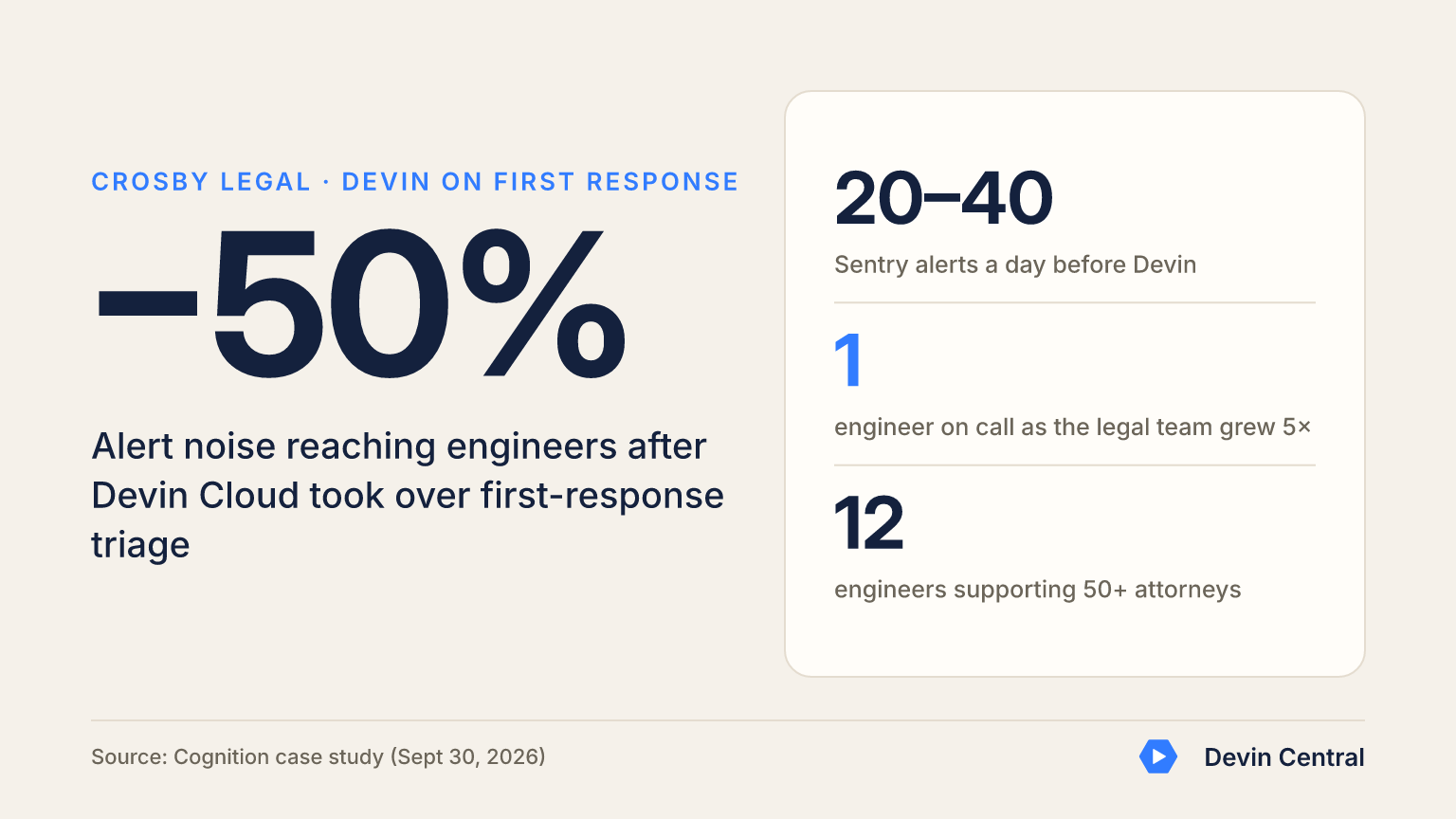
On September 30, Cognition shared a case study from Crosby Legal: 12 engineers supporting 50+ attorneys deployed Devin Cloud for first-response bug triage, handling 20–40 daily Sentry alerts. The result: 50% noise reduction in alerts that reached engineers, and on-call reduced to one engineer as the legal team scaled 5x.
This is one of the clearest examples yet of how AI agents deliver operational leverage in production support — not by replacing engineers, but by filtering the repetitive triage work that burns them out.
The problem: Sentry alert fatigue at scale
Crosby Legal is a legal technology platform serving law firms and corporate legal departments. The company’s engineering team of 12 supports over 50 attorneys using the platform daily, plus the underlying SaaS infrastructure. That ratio — roughly 4 attorneys per engineer — is unusually lean for a legal tech company, and it puts pressure on the on-call rotation.
Before Devin, the team received 20–40 Sentry alerts per day. Sentry is an error monitoring tool that captures exceptions, crashes, and performance regressions in production. Some alerts are actionable bugs. Many are noise: transient network errors, known issues awaiting a deploy, or user mistakes flagged as exceptions.
For a 12-person engineering team, 20–40 daily alerts means each engineer on-call spends 2–4 hours a day just reading stack traces, checking logs, and deciding whether an alert is a real incident or can be ignored. That’s 2–4 hours not building features, not fixing strategic bugs, and not unblocking attorneys.
The traditional fix is to hire more engineers or tighten the on-call rotation. Crosby Legal tried a different approach: put Devin on first response.
The result: one engineer on-call, even as the legal team scaled 5x
Cognition’s case study reports three outcomes:
- 50% reduction in Sentry noise reaching engineers — Devin auto-closed duplicate alerts, transient errors, and known issues awaiting a fix.
- On-call reduced to one engineer — instead of rotating three engineers to cover triage load, one engineer handles escalations while Devin handles first response.
- Legal team scaled 5x without proportional engineering headcount growth — the 12-person engineering team now supports over 250 attorneys (up from ~50 when Devin was deployed), and alert volume per engineer stayed flat.
The last point is the leverage story. Traditionally, scaling a SaaS platform 5x means hiring more engineers to handle increased alert volume, incident response, and feature requests from a larger user base. Crosby Legal scaled usage 5x and kept the engineering team at 12 people. Devin absorbed the triage load increase.
What this means for engineering leaders evaluating agents
Crosby Legal’s deployment is a template for how AI agents deliver value in production today: not as a replacement for senior engineers writing architecture, but as an automation layer for repetitive operational work that would otherwise burn out your team.
The key workflow characteristics that made Devin effective here:
- High volume, low variance: 20–40 alerts per day, most following known patterns (duplicate stack traces, transient errors, null pointer exceptions).
- Clear success criteria: Devin’s job is not to fix the bug, but to triage it — determine severity, find the relevant code, and provide enough context for a human to decide next steps.
- Existing runbooks: Crosby Legal already had internal documentation on common errors. Devin reads that documentation as part of its triage process.
For teams with similar operational workloads — high-volume bug triage, first-response incident handling, or repetitive code review patterns — Crosby Legal’s case study is proof that agents can absorb that work today, not in some speculative future.
Method: All figures (12 engineers, 50+ attorneys, 20–40 alerts/day, 50% noise reduction, 1 on-call engineer, 5x legal team growth) are from Cognition's September 30 X post. The description of how Devin integrates with Sentry is inferred from Cognition's public documentation on Devin Automations and webhook-triggered agents, cross-referenced with Crosby Legal's disclosed workflow. Sentry's role as an error monitoring tool and typical alert volume for SaaS teams are based on Sentry's public documentation and industry benchmarks.
References
- Crosby Legal case study — Cognition, September 30, 2026.
Editorial from Devin Central — news coverage by a Devin Ambassador, not Cognition. Devin is a trademark of Cognition; other product names belong to their respective owners.